
Home \ Blog \ On Hire and Off Hire Condition Surveys in UAE Explained
On Hire and Off Hire Condition Surveys in UAE Explained
September 21, 2026
A charter is a handover of a very expensive asset between two parties who will not see each other again until something goes wrong. An on hire condition survey and its matching off hire survey exist to record exactly what changed while the charterer had the vessel, and both draw on the same marine and offshore capability. Done well, the pair settles a dispute in an afternoon. Done casually, they become the dispute. This article covers what the surveyor records, how bunkers are measured, why both parties should attend, and where charter arguments in the Gulf actually start.
Key Takeaways
- The value is in the pair. An on hire survey with no matching off hire survey, or two surveys done to different standards, proves very little about what changed.
- Bunker quantity is the single most disputed item. Measure it properly, at the same tanks, by the same method, with both parties present.
- Photographs with time, date and position are the backbone of the record. Written descriptions alone rarely settle an argument about a dent.
What the Two Surveys Are For
An on hire survey records the condition of a vessel at the moment she is delivered into a charter. An off hire survey records it at redelivery. The difference between the two is what the charterer is answerable for, subject to fair wear and tear and to whatever the charter party actually says.
The distinction between damage and wear is where most disagreement lives, and it is a matter of contract rather than of surveying. The charter party defines the redelivery condition, and a competent surveyor reads it before attending rather than applying a generic standard. A clause requiring redelivery in the same good order as on delivery reads very differently from one that accepts ordinary wear.
Both surveys should be carried out to the same scope, in the same sequence, and ideally by the same surveyor or at least the same firm. Comparability is the entire point. Two reports written to different templates by different people invite an argument about whether a difference is real or just a difference in reporting.
The type of charter shapes the emphasis. Under a time charter the owner keeps the crew and the technical management, so the survey focuses on cargo spaces, hull and equipment condition and consumables. Under a bareboat charter the charterer takes the whole vessel, and the survey has to be correspondingly more thorough because far more can change during the period.
Scope should also match the trade. A vessel going onto a dredging support or offshore construction charter in the Gulf will be working alongside barges, handling wires and taking chafe in ways a liner trade vessel never does, so the fendering, deck edge, bulwarks and mooring equipment deserve far closer attention at delivery than a generic template would give them. Recording the pre existing condition of exactly the areas the trade will punish is what makes the off hire comparison useful.
What the Surveyor Actually Records
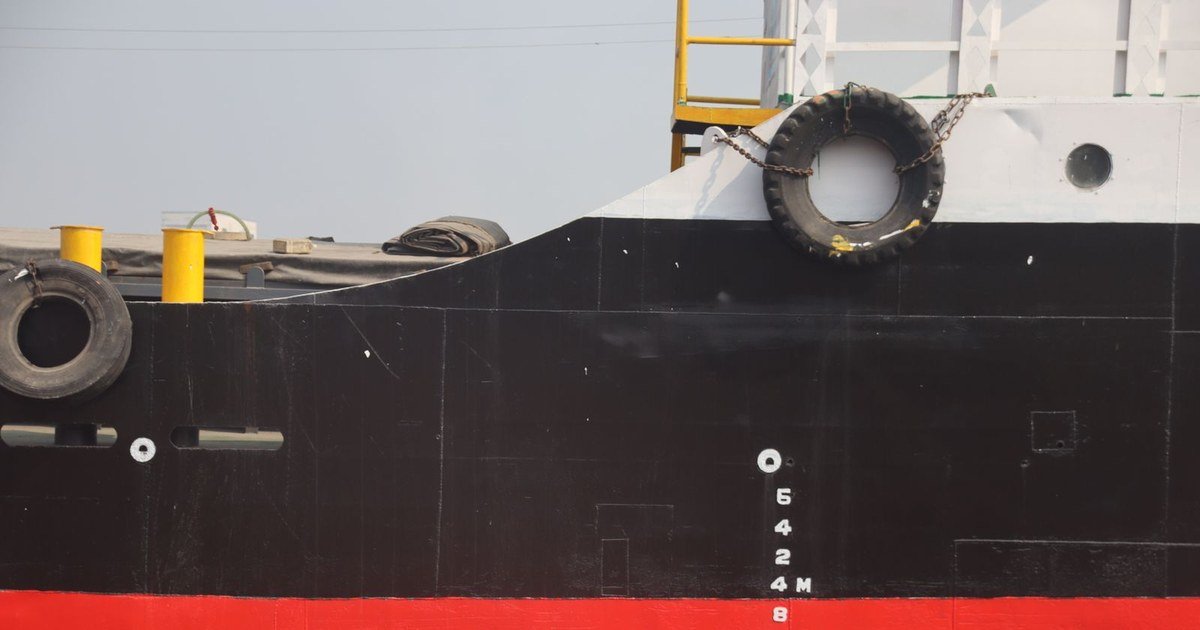
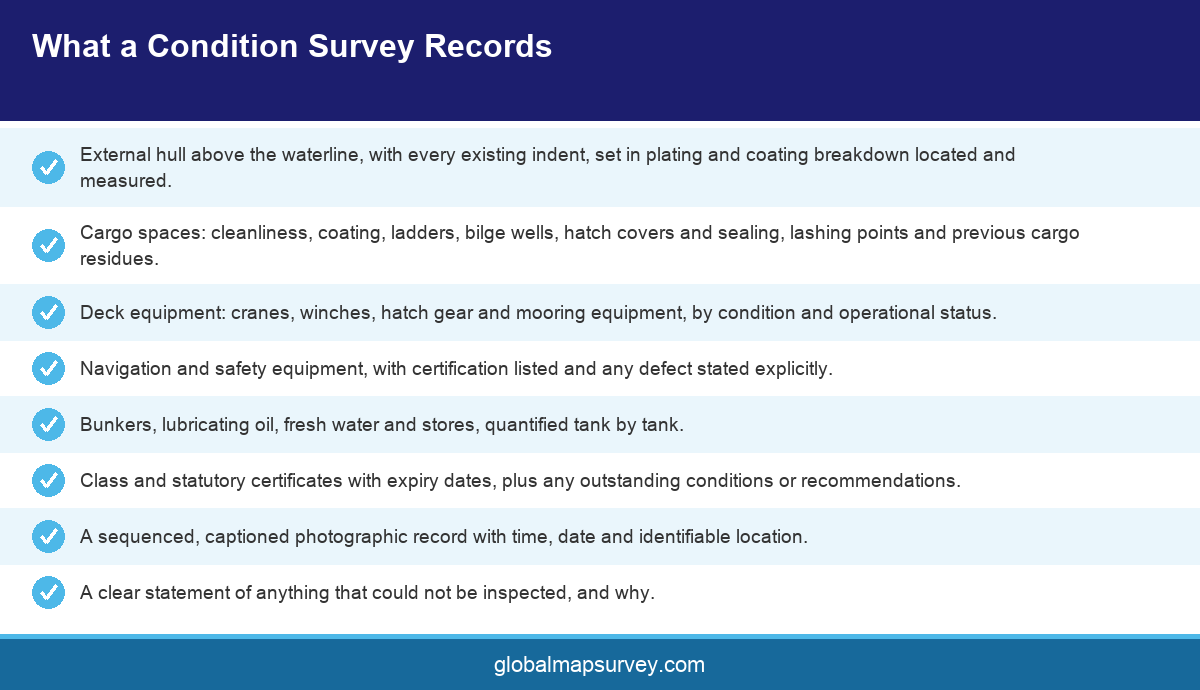
The hull is documented externally, above the waterline, with attention to the shell plating, boot topping, bulwarks, fenders and any existing indents, set in plating or coating breakdown. Every existing defect is located, measured and photographed, because an unrecorded defect at delivery becomes the charterer damage at redelivery.
Cargo spaces come next. Hold or deck condition, cleanliness, coating, ladders, bilge wells, hatch covers and their sealing arrangements, lashing points and any residues from previous cargo are all recorded. On a project cargo or heavy lift vessel the deck strengthening and lashing arrangements matter as much as the hold.
Machinery and equipment are recorded by condition and by operational status rather than by inspection in the class sense. Cranes, winches, hatch operating gear, mooring equipment, navigational and safety equipment and their certification are all noted, with anything defective or out of date listed explicitly.
Consumables and certificates complete the record. Bunkers, lubricating oil, fresh water and stores are quantified. Class and statutory certificates are listed with expiry dates. Any outstanding class conditions or recommendations are recorded, because a condition that expires during the charter becomes a live commercial problem for whoever is holding the vessel at the time.
Bunkers, and Why They Cause Most Disputes
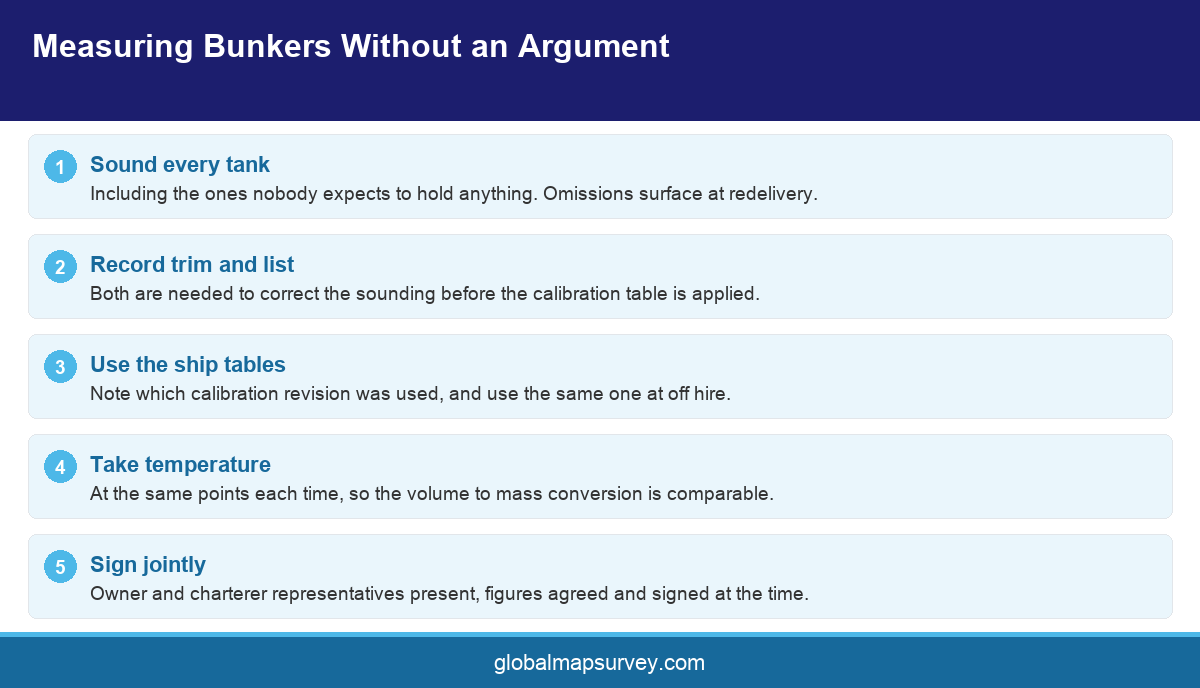
Bunker quantity is money, it changes constantly, and it is measured indirectly. Those three facts make it the most argued item in charter surveying. The quantity is derived from sounding or ullage measurements, corrected for trim and list, converted through tank calibration tables, and adjusted for temperature and density. Every step in that chain can be done differently.
The practical protection is procedural rather than technical. Measure every tank, including the ones nobody expects to hold anything. Use the same method at on hire and off hire. Record trim and list at the time of sounding. Take temperature at the same points. Use the vessel own calibration tables and note which revision was used.
Attendance matters more here than anywhere else in the survey. Soundings taken with representatives of both owner and charterer present, and signed by both at the time, remove almost all subsequent argument. Soundings taken by one party alone are simply that party figure.
Fuel quality is a separate question from quantity and is worth agreeing in advance. Where the charter requires representative samples at delivery and redelivery, the sampling point, method and the number of sealed samples should be recorded in the survey report alongside the quantity figures.
Where Gulf Charter Disputes Start
Timing is the first and most common cause of trouble. A survey carried out several hours or even several days after delivery leaves an unrecorded window in which anything at all might have happened, and that window is exactly where a later argument will settle. The report should state the exact time of the survey and the exact time of delivery, and where there is a gap it should say so plainly rather than blur the two together.
Location is the second. Surveys carried out at anchorage in a swell, or alongside at night, produce thinner records than surveys carried out in daylight alongside a berth. Where conditions limited the inspection, the report must say which parts were not accessible instead of leaving the reader to assume full coverage.
Photography is the third and the most fixable. A photograph without time, date and identifiable location proves very little. Modern practice is a comprehensive photographic record, sequenced and captioned, with general views establishing context before every close up. The regional working environment adds a practical note here, because heat haze and strong contrast in the middle of the day degrade external photography noticeably.
Ambiguous language is the fourth. Descriptions such as good condition, minor scoring or slight corrosion mean different things to different readers and are almost useless a year later. Locate every observation to a frame number, a compartment or a named fitting, give it a measured dimension where one applies, and attach the photograph reference. A record built that way survives a change of personnel on both sides, which is exactly the situation in which it will eventually be read.
Scope creep is the fifth. An on hire survey is a condition record, not a class survey, not a structural assessment and not a detailed asset inspection. Where a party wants engineering conclusions about a defect, that is a separate instruction with a separate scope, and mixing the two weakens both.
Conclusion
An on hire condition survey in UAE only earns its fee if its off hire partner is done to the same scope by the same standard. Read the charter party before attending, record every existing defect with a located and captioned photograph, measure bunkers by an agreed method with both parties present, and state plainly what could not be inspected. That is what turns two reports into evidence rather than two opinions. To arrange condition surveys for a charter in Abu Dhabi, Dubai or the wider Gulf, contact the Global Maps Survey marine team.
AN ISO 9001-2015 CERTIFIED COMPANY