
Home \ Blog \ Bridge Settlement Surveys in UAE: Dams, Tunnels and Walls
Bridge Settlement Surveys in UAE: Dams, Tunnels and Walls
August 26, 2026
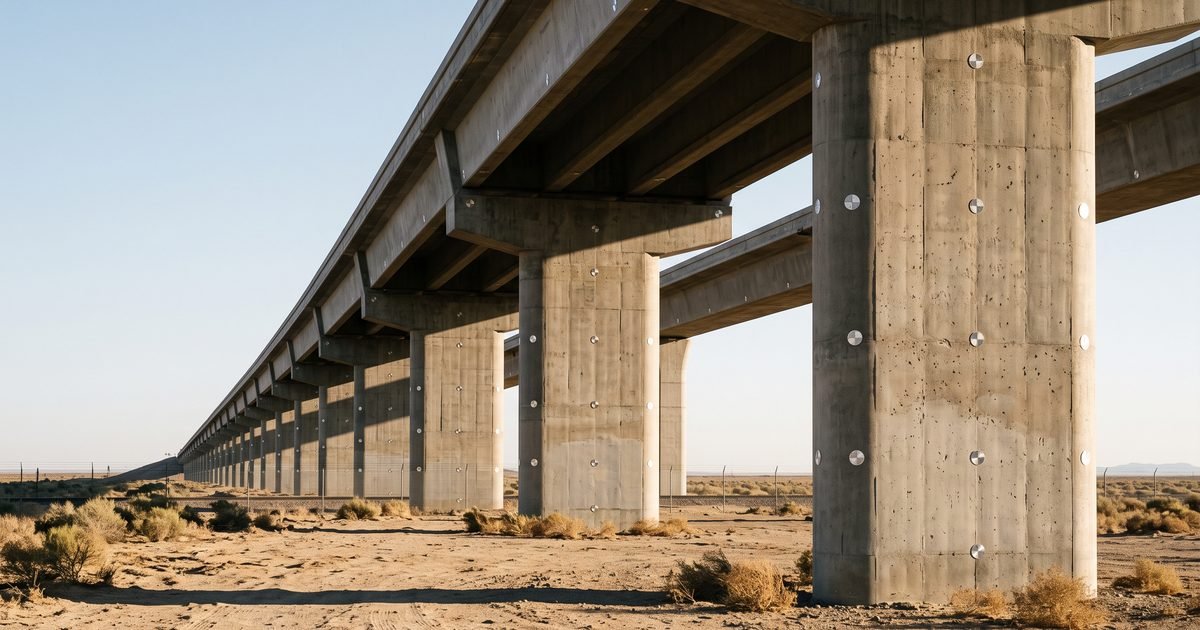
Monitoring a bridge is not monitoring a building with a longer span. Bridge settlement surveys in UAE deal with structures that flex under live load, sit on separate foundations that can move independently, and cannot usually be closed for the survey. Dams, tunnels and retaining walls each add their own constraints. This guide covers what changes when the structure is infrastructure rather than a building.
Key Takeaways
- Bridges move constantly under traffic and temperature. The survey has to separate that from permanent settlement.
- Differential movement between adjacent supports usually matters more than total movement of the whole structure.
- Access windows, not survey accuracy, are typically the binding constraint on infrastructure monitoring.
Why Bridges Are Harder Than Buildings
A bridge deck deflects under every vehicle that crosses it and expands and contracts through the daily temperature cycle. Both effects are reversible and both are usually much larger than the permanent settlement the survey is trying to detect. Readings taken without controlling for them are close to meaningless.
Controlling for load usually means observing during defined low traffic windows, or measuring supports rather than the deck where the question is foundation settlement. Controlling for temperature means reading at consistent times and recording conditions, so that the thermal signature can be recognised and set aside.
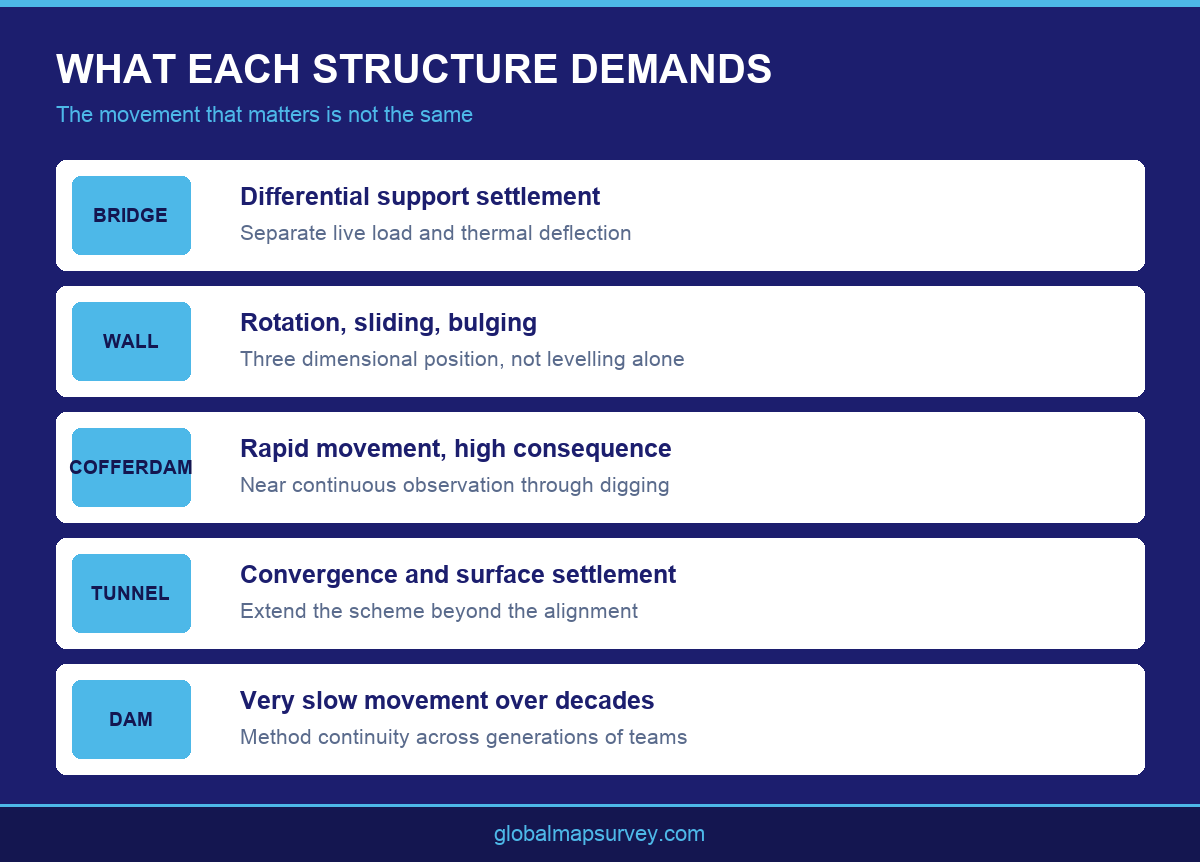
The other complication is that bridges sit on multiple independent foundations. Piers may be founded at different depths in different material, and each can settle at its own rate. This makes differential movement between adjacent supports the primary concern, which in turn drives where the monitoring points go.
Bearings and expansion joints deserve separate attention. They are designed to accommodate movement, so their condition affects how the structure responds to settlement elsewhere. A seized bearing changes the load path and can turn modest foundation movement into significant stress in the deck, which is why monitoring briefs on older bridges often include them explicitly rather than treating the deck as a single element.
Foundation type usually explains why one pier moves and its neighbour does not. Piled supports founded in competent material behave very differently from shallow foundations on variable ground, and a bridge can easily have both along its length. Reviewing the foundation records before designing the scheme shows where differential movement is most plausible, and concentrates the monitoring effort where it will actually earn its cost.
Retaining Walls and What They Do Before They Fail
A retaining wall under distress does not usually settle. It rotates, slides forward, or bulges in the middle while the top and bottom stay roughly in place. A monitoring programme built around levelling will detect none of that reliably.
Wall monitoring therefore has to measure position in three dimensions and, ideally, tilt as well. Points along the top of the wall show translation and rotation. Points at intermediate heights show bulging, which is often the earliest visible sign that lateral earth pressure is exceeding what the wall was designed for.
Where a wall retains an active excavation, movement can develop quickly as each dig stage removes support. Monitoring frequency needs to follow the excavation sequence closely, and trigger levels should reflect that a wall approaching its limit gives relatively little warning.
Drainage behind a wall is frequently the underlying issue. Blocked weep holes and failed drainage raise water pressure behind the structure, and the resulting movement can look like a structural problem when the cause is maintenance. Monitoring will show the movement clearly, but the investigation that follows should look at drainage before concluding the wall was underdesigned.
Cofferdams and Temporary Works
A cofferdam is a temporary structure holding back water or ground while permanent work proceeds inside it. Because it is temporary, it is often designed to smaller margins than permanent works, and because it is holding back water the consequence of failure is immediate.
That combination makes monitoring of cofferdams one of the few situations where continuous or near continuous observation is routinely justified. Movement of the sheet piles or walls, and of the ground behind them, is tracked through every stage of excavation and dewatering.
Temporary works monitoring also has a defined end. Once the permanent structure takes the load, the cofferdam is removed and the programme closes. Scoping this properly avoids both the trap of monitoring a redundant structure and the more serious trap of stopping before the permanent works are actually carrying load.
The surrounding ground matters as much as the cofferdam itself. Dewatering inside the excavation lowers groundwater outside it too, and that can settle neighbouring structures that have no physical connection to the works. A scheme limited to the cofferdam walls will not see that happening, which is why the monitoring footprint normally extends outward into the surrounding area as well.
Tunnels and Dams
Tunnel monitoring concerns itself with convergence, meaning the lining closing in on itself, as well as settlement of the tunnel and of the ground and structures above it. Surface settlement above a tunnel drive often affects buildings that have no connection to the project at all, which makes the monitoring scheme extend well beyond the tunnel alignment.
Dams are monitored over decades rather than months. The concerns are movement of the structure, settlement of the foundation and deformation of embankments, tracked slowly and consistently over a very long period. Continuity of method matters enormously, because a reading taken this year has to be comparable with one taken many years earlier.
In both cases the monitoring outlives the project team that commissioned it. Documentation, point records and method statements need to be written for someone who was not there, which is a different standard of record keeping from a twelve month construction programme.
Instrumentation for these structures is often embedded during construction rather than fixed afterwards. Points cast into a dam or tunnel lining at the time of building give far better long term stability than anything attached later, and they can reach positions that would be inaccessible once the structure is complete. That requires the monitoring scheme to be designed during the works, not after them. The same principle applies to structural settlement surveys on any major asset.
Access Is Usually the Real Constraint
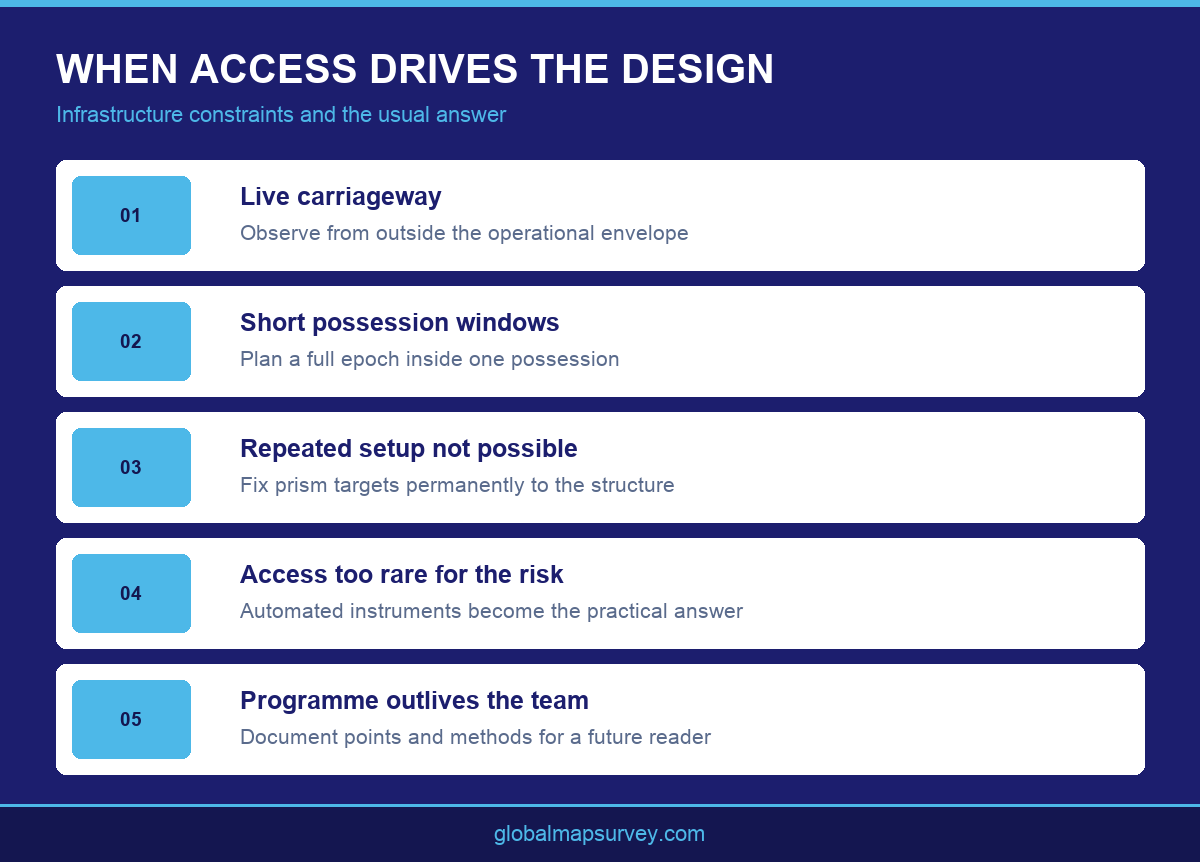
On infrastructure, the limiting factor is rarely whether the required accuracy is achievable. It is whether the survey team can reach the points at all. Live carriageways, operational rail, restricted marine access and confined tunnel environments all shrink the available window sharply.
This shapes the design of the whole programme. Points may need to be observable from outside the operational envelope. Prism targets may be fixed permanently so that no one has to return to the structure to set up. Observation routines are planned so a full epoch can be completed inside a single possession.
Where windows are too short or too infrequent, automated monitoring with fixed instruments becomes the practical answer rather than a premium option. The installation cost is offset against not needing repeated access, and the data density is usually far higher than manual visits could achieve. Precise levelling of the kind used in precise levelling campaigns still underpins the vertical component wherever access allows.
Data volume becomes its own challenge once automation is involved. A continuous system produces far more readings than anyone will review manually, so the value depends on filtering, alarms and summary reporting rather than on raw output. Agreeing what triggers a notification, and what simply accumulates in the record, is part of designing the scheme rather than an afterthought. Broader deformation monitoring schemes face the same question.
Conclusion
Bridge settlement surveys in UAE, and monitoring of dams, tunnels and retaining walls, differ from building work in three ways: the structures move under load, the movement that matters is usually differential, and access governs the design. Programmes built around those realities produce data engineers can use. Global Maps Survey Services monitors major structures across Abu Dhabi and the UAE. Contact our infrastructure monitoring team to discuss your asset.
AN ISO 9001-2015 CERTIFIED COMPANY