
Home \ Blog \ Marine Warranty Survey in UAE: What Underwriters Require
Marine Warranty Survey in UAE: What Underwriters Require
September 18, 2026
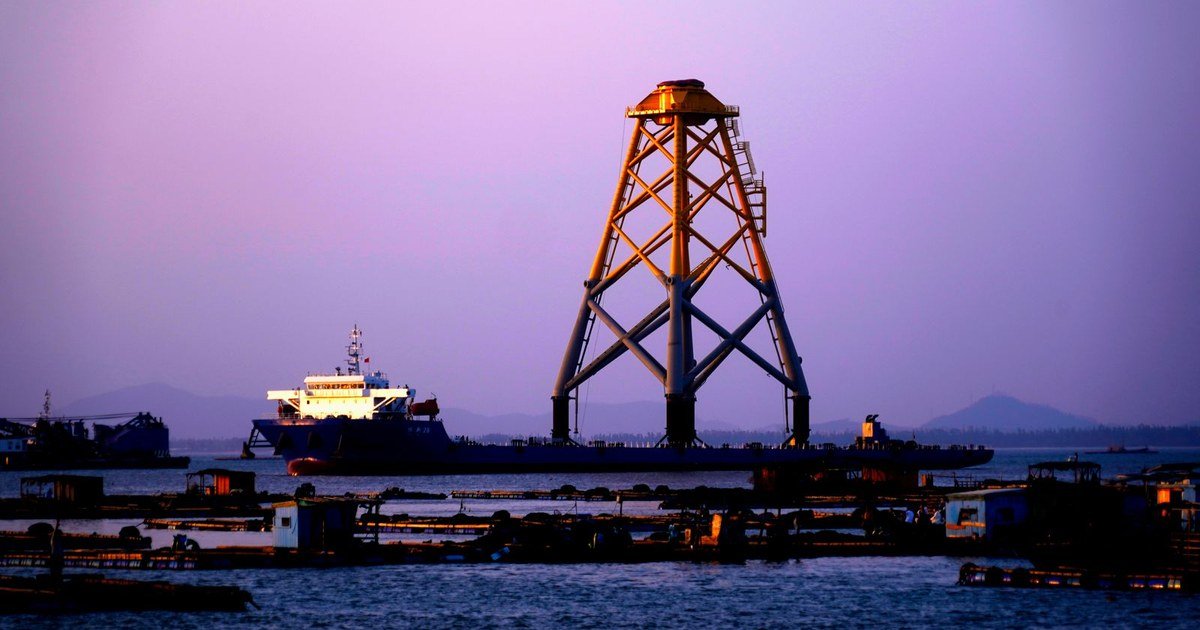
A Global Map Survey’s marine division is not a quality inspection. It is a condition of insurance. An independent surveyor appointed on behalf of underwriters reviews a marine operation before it happens, and issues a certificate of approval without which cover for that operation does not attach. This article explains who appoints the surveyor, which operations need approval, what documentation is reviewed, how the attendance works, and why the certificate is so often the item holding up a load out at the quayside.
Key Takeaways
- The marine warranty surveyor acts for the underwriter, not for the contractor. Their independence is the point of the appointment and it shapes how the review runs.
- Approval is granted against submitted documentation. Late or incomplete submissions, not unsafe operations, cause most certificate delays.
- Engage early. A surveyor brought in at concept stage can shape the method. One brought in the week before load out can only approve or refuse it.
Who the Surveyor Works For
Marine warranty survey exists because insuring a high value marine operation is a large single exposure. Underwriters manage it by requiring an independent competent party to review the plan and confirm the operation can be carried out with acceptable risk. That party is the marine warranty surveyor, and the policy usually names the requirement explicitly as a warranty.
The distinction that matters commercially is the direction of duty. Although the contractor or project owner normally pays the fee, the surveyor reports to underwriters. They are not part of the project team, they do not supervise the work, and they do not take on the contractor design responsibility. Their output is an opinion on risk expressed as approval, approval with conditions, or refusal.
That independence is also why the surveyor cannot simply be persuaded. Conditions attached to a certificate are not negotiating positions. They are the basis on which cover attaches, and proceeding outside them can leave a loss uninsured even where the operation itself went perfectly well.
The framework is set out in policy wording rather than in a single global standard, and practice is informed by guidance from bodies including the International Marine Contractors Association and the classification and P and I community. Projects in the Emirates are usually placed on international terms, so those references apply directly.
Which Operations Need Approval
Load out is the most common trigger. Moving a fabricated module, jacket, bridge span or vessel section from the fabrication yard onto a barge concentrates enormous value into a short, irreversible operation, and it is checked closely. Quay strength, ballast plan, skid or SPMT arrangement, tidal window and weather criteria all fall inside the review.
Transportation follows. Seafastening design, barge stability and motion response, the tow plan, the route, the weather forecasting arrangement and the departure criteria are reviewed together. For a voyage inside the Gulf the review is usually short. For an ocean tow it is not.
Installation and lifting come next. Heavy lifts, monopile and jacket installation, module lifts onto an offshore structure and float over operations all attract a review of the rigging, the vessel capability, the contingency plans and the limiting environmental conditions.
The Emirates adds a regional pattern worth knowing. A great deal of module and jacket fabrication happens in yards around Musaffah, Jebel Ali and Hamriyah, and the operations that follow are frequently short intra Gulf tows to a field or a port project rather than ocean voyages. That shortens the transportation review but concentrates attention on the load out itself, because quayside constraints, restricted turning basins and shallow approach channels do more to shape those operations than the sea passage does. Depth and clearance evidence at the berth therefore carries unusual weight in a regional submission.
Beyond those, dredging campaigns, cable and pipeline lay, jack up rig moves, mooring installation and salvage each attract warranty involvement depending on how the policy is written. The practical rule is that if the operation is high value, short duration and difficult to reverse, someone will want it approved.
What Gets Reviewed and When
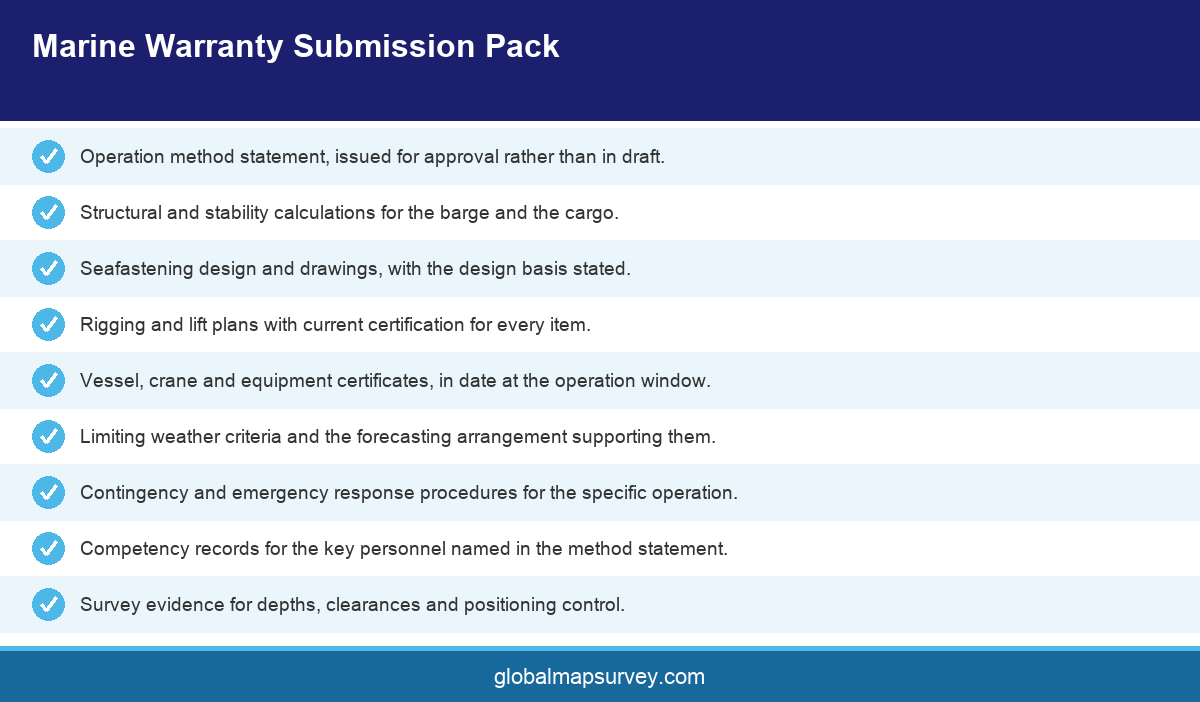
The review is documentary first and physical second. A typical submission includes the operation method statement, structural and stability calculations, seafastening design and drawings, rigging and lift plans with certification, vessel and equipment certificates, weather criteria and the forecasting arrangement, contingency and emergency procedures, and the competency records of key personnel.
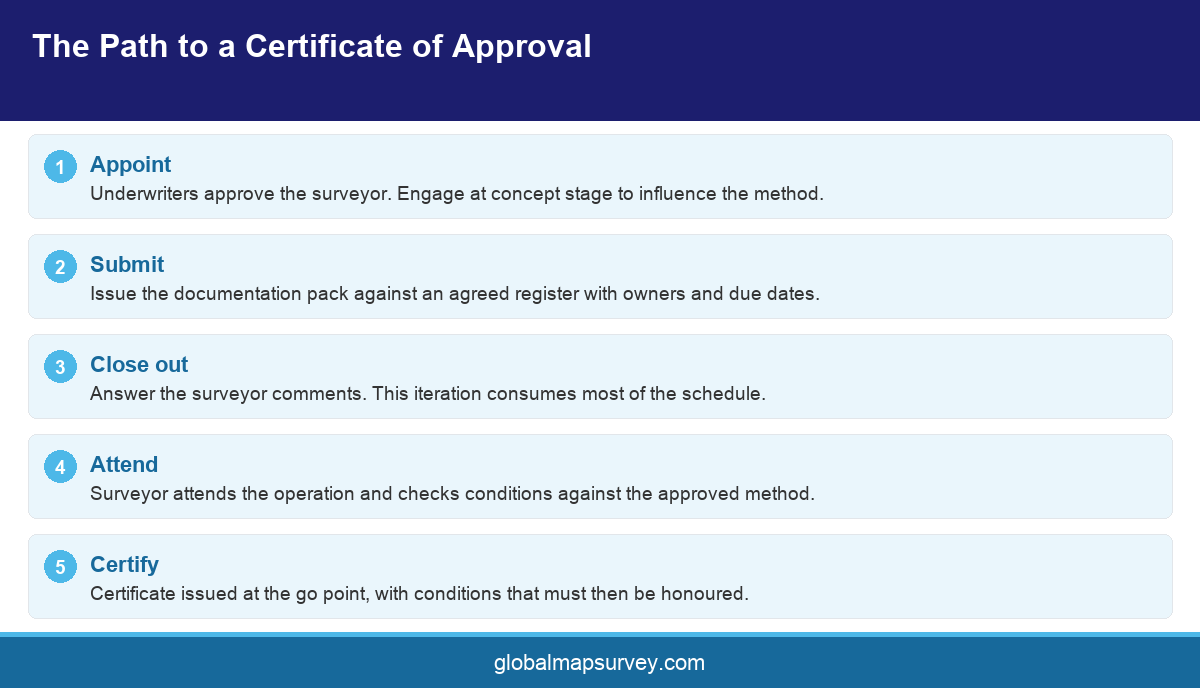
The surveyor reviews these against the operation risk, raises queries, and issues comments that have to be closed out. That iteration is where the schedule is really consumed, and it is entirely predictable. A submission made three weeks before the window with all supporting calculations attached closes out comfortably. One made five days before, missing the stability report, does not.
Physical attendance follows. The surveyor attends the operation itself, confirms that conditions are as documented, checks that the weather criteria are being applied honestly, and either issues or withholds the certificate at the go or no go point. A vessel and equipment condition record compiled in advance shortens that attendance considerably.
Where a survey scope supports the operation, its evidence forms part of the submission. Quay and berth bathymetry, under keel clearance at the load out and tow route, and the survey control used for positioning are all items an experienced surveyor will ask to see rather than assume.
Keeping the Certificate Off the Critical Path
The single most effective measure is early appointment. A surveyor engaged at concept can flag that a proposed seafastening arrangement will not be acceptable while the design can still change. The same surveyor engaged a fortnight before load out can only approve what exists.
The second is a submission register agreed at the start, listing every document required, who owns it, and the date it is due. Most delays trace to a single missing calculation that nobody was assigned to produce, and a register makes that visible weeks in advance.
A related habit is to nominate one person as the single channel to the surveyor. Warranty reviews generate a stream of comments that touch naval architecture, structural engineering, rigging and operations, and when each discipline answers separately the responses arrive inconsistent and incomplete. One coordinator who holds the comment register, chases the owners and issues a consolidated response closes a review far faster than four specialists replying in parallel.
The third is honest weather criteria. Operations are approved against limiting conditions, and those limits are checked at the go point. Criteria written optimistically to widen the window get tested the moment the forecast tightens, and the resulting argument happens with the barge on the berth and the crew on overtime.
The fourth is understanding what the surveyor will actually push back on. In practice the recurring themes are thin margins on stability, seafastening designed for a smaller motion envelope than the route justifies, rigging certification that expires inside the operation window, and weather criteria that are stated but not tied to a named forecast provider and a defined decision point. Reviewing a submission against those four before it is issued removes most of the comment cycle before it starts.
The fifth is documented survey evidence, supplied up front rather than on request. Where the operation depends on a depth, a clearance or a position, provide the bathymetric survey record rather than a statement. Evidence closes a query in one exchange. Assertion generates three.
Conclusion
A marine warranty survey in UAE protects an insurance position, and the certificate is what releases the operation. Treat it as a schedule item with its own critical path rather than as a formality someone will handle. Appoint early enough to influence the method, agree a submission register with named owners and dates, write weather criteria you will actually honour, and back every clearance claim with survey evidence. To provide the survey evidence a warranty submission needs in Abu Dhabi or Dubai, contact Global Maps Survey.
AN ISO 9001-2015 CERTIFIED COMPANY