
Home \ Blog \ Settlement Monitoring Survey Abu Dhabi: Choosing a Contractor
Settlement Monitoring Survey Abu Dhabi: Choosing a Contractor
August 31, 2026

Monitoring quotes are unusually hard to compare. Two providers can price the same settlement monitoring survey in Abu Dhabi with a large gap between them, and the difference is rarely visible in the scope wording. It normally sits in the reference network, the accuracy actually achieved and who does the reading. This guide sets out the questions that expose those differences before you award.
Key Takeaways
- Compare the reference network design first. It is the most common place cost is quietly removed.
- Ask for accuracy as a verified site figure, not a manufacturer specification.
- Continuity of personnel and method matters more on monitoring than on almost any other survey work.
Why Monitoring Quotes Are Hard to Compare
A monitoring scope written as a number of points read at a stated frequency looks precise but leaves the important variables undefined. It says nothing about how many reference points will be established, how they are founded, what accuracy will be achieved or how stability is verified.
Those variables are where the cost lives. Establishing a properly founded reference network outside the zone of influence takes time and materials, and it is invisible in the deliverable. A provider who trims it can quote lower for what reads as identical scope.
The practical response is to specify those items yourself rather than leaving them to the bidder. Once reference point count, founding, accuracy and verification are in the enquiry, the quotes become comparable and the conversation shifts from price to method.
Mobilisation is the other hidden variable. Installing points, establishing the reference network and proving the baseline is front loaded work that happens before the first useful reading is delivered. A quote that appears cheap per visit may simply have moved that cost into a setup charge, or omitted it entirely on the assumption that existing points can be reused.
Questions That Expose the Difference
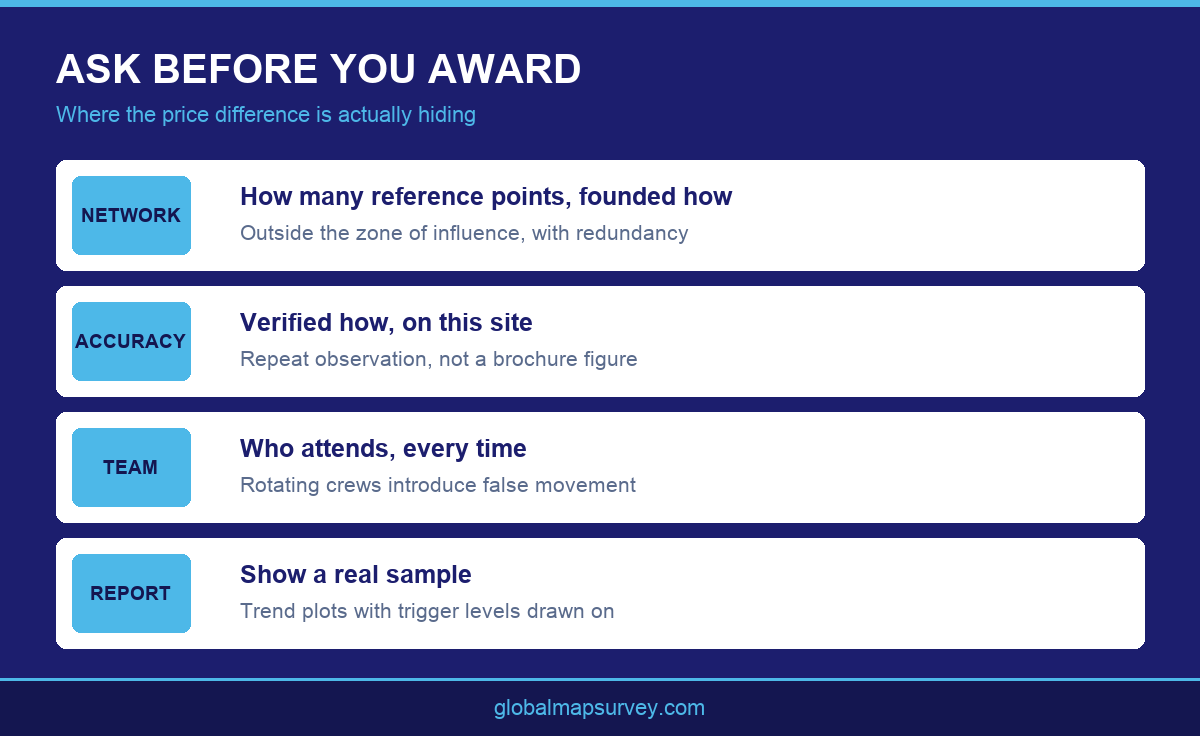
Ask how many reference points will be established, where they will sit relative to the works, and how their stability will be checked during the programme. A provider planning genuine redundancy will answer immediately. A provider intending to work from two convenient points will answer vaguely.
Ask what accuracy will be achieved on site and how it will be demonstrated. The right answer involves repeat observation under working conditions, not a figure copied from an instrument brochure. Ask specifically how that accuracy compares with the smallest trigger level, since that ratio determines whether readings near the trigger will be interpretable at all.
Ask who will attend. Monitoring depends on the same routine being executed identically over many months, and a rotating cast of technicians introduces variation that looks like movement. A provider who names a team and commits to continuity is offering something materially different from one who does not.
Ask what happens when something goes wrong. Points get destroyed, instruments fail and access gets refused, and every long programme meets at least one of these. A provider who can describe how they recover a damaged point, or cover a missed reading, has run programmes before. One who treats the question as hypothetical probably has not.
Accreditation, Method and Local Experience
Certification indicates that a provider operates a documented management system with procedures that are audited. On a programme that runs for months and produces evidence, that matters more than on a one off topographic job, because consistency of method is what makes the data defensible. Our own quality management system governs how monitoring procedures are recorded and followed.
Ask for a method statement rather than a brochure. It should say what will be observed, from where, with what, at what accuracy, how often, and what happens when a trigger is approached. If the document cannot answer those questions, the programme has not been designed.
Local experience is worth weighting on monitoring specifically. Ground conditions across Abu Dhabi, daily temperature range, dust and site access all affect what a monitoring scheme has to cope with, and providers who have run programmes here will have designed around those conditions before. The Department of Municipalities and Transport governs much of the built environment framework in the emirate, and familiarity with local requirements shortens the mobilisation.
Insurance and liability are worth confirming as well, particularly where monitoring supports a dispute. The value of a monitoring record depends partly on the standing of the organisation that produced it, and a provider whose cover does not extend to the consequences of a missed exceedance is offering a weaker product than the scope alone suggests.
Reporting You Can Actually Use
Ask to see a sample report before awarding, not a description of one. The sample shows immediately whether movement is presented against baseline, against the previous reading and against trigger levels, and whether a project manager could reach a conclusion from it without doing arithmetic.
Time series plots are the test. A report consisting of coordinate tables contains the data but hides the trend, and trend is the entire point. Trigger levels drawn onto the plots make exceedance obvious at a glance, which is what allows monitoring data to be discussed in a progress meeting rather than filed.
Turnaround should be specified too. Monitoring data that arrives two weeks after the reading cannot support a decision about work happening now. On active programmes the interval between observation and issued report needs to be short enough that the information is still actionable.
Ask how the data will be delivered as well as reported. Some clients want a formatted document, others want the underlying readings in a form their own engineer can work with, and some need both. Agreeing this before the programme starts avoids the common situation where months of readings exist only inside a series of formatted reports and cannot easily be analysed as a whole. Where automated monitoring is involved, data access arrangements matter even more.
Ask how exceedances will be communicated as well as reported. A trigger reached on a Thursday evening is of little use if it appears in a scheduled report the following week. Providers running serious programmes will describe an immediate notification route, naming who is called and within what period, entirely separately from the routine reporting cycle.
Scoping the Programme Before You Go Out to Tender
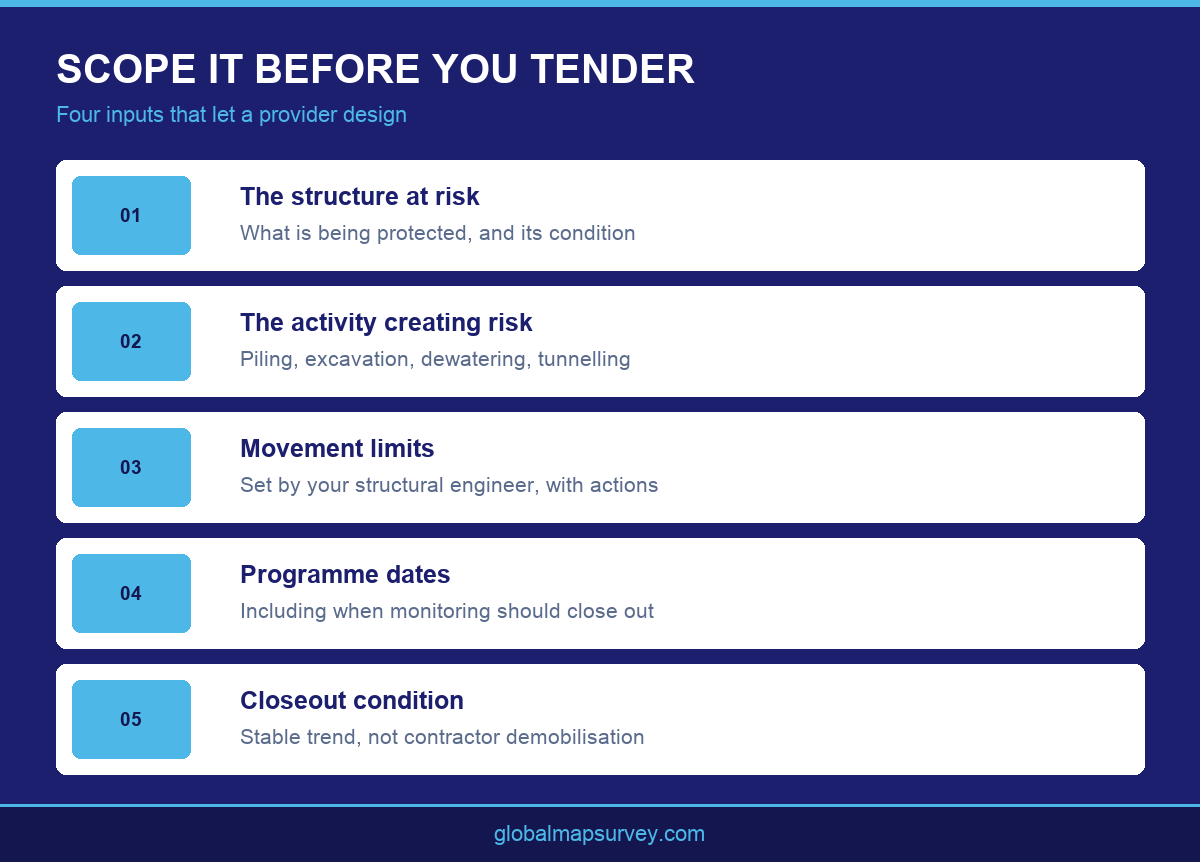
Better enquiries produce better quotes. Before approaching providers, establish what structure is at risk, what activity creates the risk, what movement limits the structural engineer has set, and the dates over which the works run. Those four items let a provider design rather than guess.
Levelling remains the foundation of most settlement work, and understanding what levelling can and cannot deliver helps in reading proposals critically. Where movement could be lateral rather than vertical, the enquiry needs to say so, because that changes the method entirely.
It is also worth stating what happens at the end. A programme that closes when the contractor demobilises may stop before movement does. Specifying that monitoring continues until readings show a stable trend for an agreed period puts every bidder on the same basis and avoids a variation later. Our building settlement monitoring and survey consultancy teams can help shape a scope before it goes out.
Finally, consider how the programme might need to change. Construction sequences slip, excavation goes deeper than planned and additional structures come into scope. A provider who prices variations transparently at the outset is far easier to work with than one whose low initial figure is followed by a series of change requests. Our monitoring services are scoped with that flexibility in mind.
Conclusion
Choosing a provider for a settlement monitoring survey in Abu Dhabi comes down to what sits beneath the headline scope: the reference network, the verified accuracy, the continuity of the team and the usability of the reporting. Specify those in the enquiry and the quotes become genuinely comparable. Global Maps Survey Services runs monitoring programmes across Abu Dhabi and the UAE under a certified management system. Contact us to scope your programme.
AN ISO 9001-2015 CERTIFIED COMPANY