
Home \ Blog \ Railroad Monitoring Services in UAE: Track Geometry Explained
Railroad Monitoring Services in UAE: Track Geometry Explained
August 27, 2026
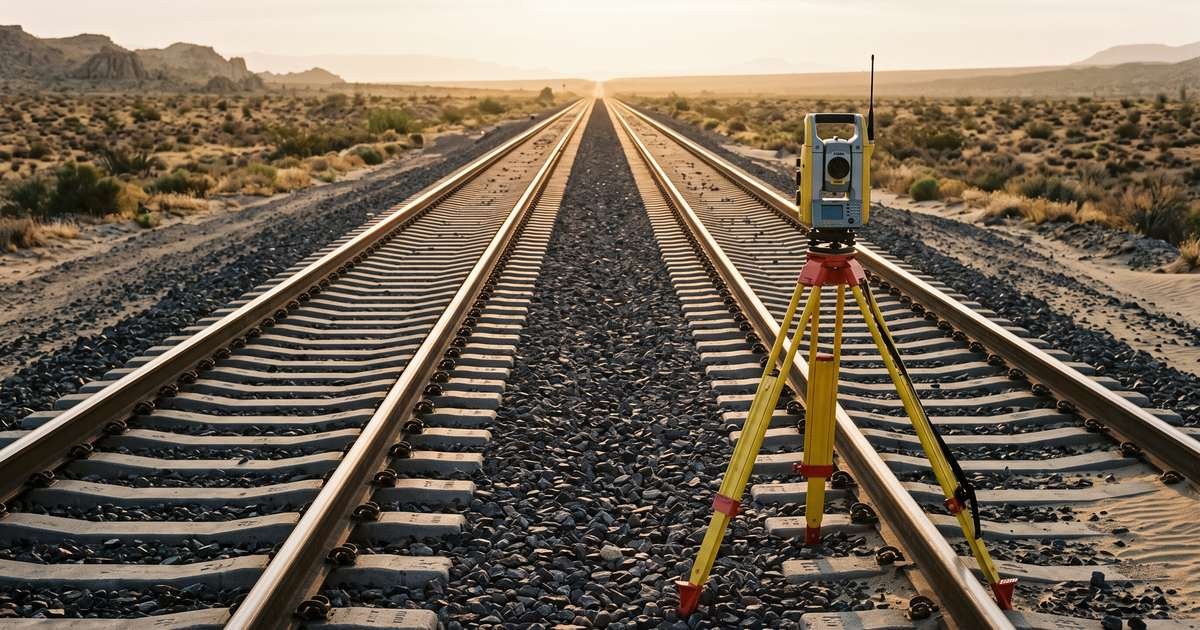
Rail is unforgiving about movement in a way that most structures are not. A few millimetres of differential settlement under a track can change how a train rides over it. Railroad monitoring services in UAE track both the geometry of the track itself and the structures carrying it, usually inside possession windows measured in hours. This guide explains what gets measured, why, and how the constraints shape the survey.
Key Takeaways
- Track geometry and structure movement are two different monitoring problems that often run on the same site.
- Possession windows, not accuracy, usually determine how a rail monitoring programme is designed.
- Adjacent construction is the most common reason rail monitoring is commissioned, and the operator sets the limits.
Track Geometry and Structure Movement
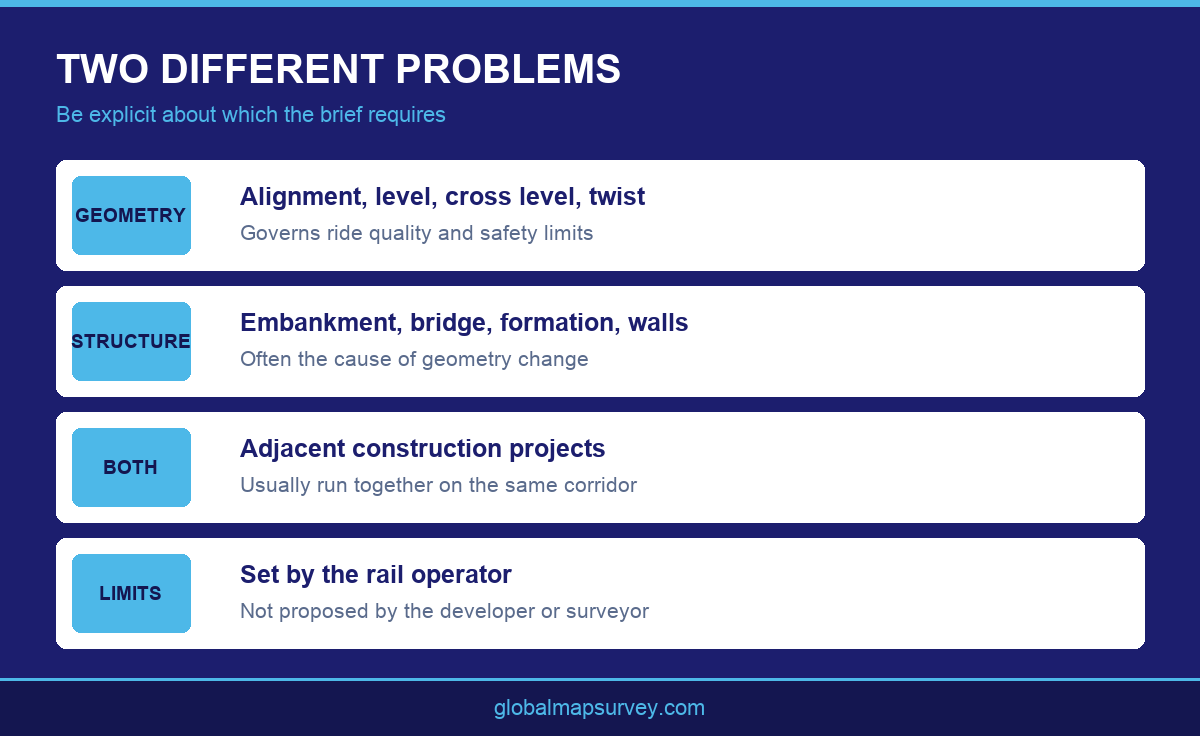
Track geometry describes the position and shape of the rails themselves, including alignment, level, cross level between the two rails, and twist along the track. These parameters govern ride quality and safety, and they have tolerances that are tighter than most structural work.
Structure movement is a separate question. It covers settlement of embankments and formation, movement of bridges and underbridges carrying the line, and displacement of retaining walls alongside it. Structure movement often causes track geometry change, but the two are measured differently and reported to different people.
A monitoring brief needs to be explicit about which is required. Asking for rail monitoring without specifying whether the concern is geometry or structure leads to a scheme that measures the wrong thing, which on rail is expensive to discover late.
Ballast and formation behaviour sits between the two. Track geometry can degrade because the ballast is deteriorating rather than because anything structural has moved, and the remedy is maintenance rather than engineering intervention. A monitoring scheme that reports geometry change without any structural context leaves the operator unable to tell which of those two situations they are looking at.
Why Adjacent Construction Triggers Most Programmes
The majority of rail monitoring in the region is commissioned not by the railway but by someone building near it. Excavation, piling, dewatering and tunnelling close to a live alignment can all move the formation beneath the track, and operators require the risk to be managed and evidenced.
In that situation the operator, not the developer, sets the movement limits and often the reporting requirements. Those limits tend to be tight and non negotiable, because the consequence of exceedance is a speed restriction or a line closure. Understanding them before designing the scheme avoids proposing a programme that cannot meet the required sensitivity.
Baseline is critical here for the same reason it is on buildings. Readings must begin before any works that could influence the formation, and continue until the works are complete and readings are stable. Where wider ground settlement monitoring runs across the site, the rail corridor is normally treated as a separate and more sensitive zone within it.
Adjacent works also create obligations that outlast the construction programme. Operators commonly require monitoring to continue after the works finish, until readings demonstrate that the formation has stabilised. Budgeting only for the construction period is a frequent cause of awkward late variations, and it is easily avoided by asking the operator about closeout requirements during the approvals process.
Working Inside a Possession
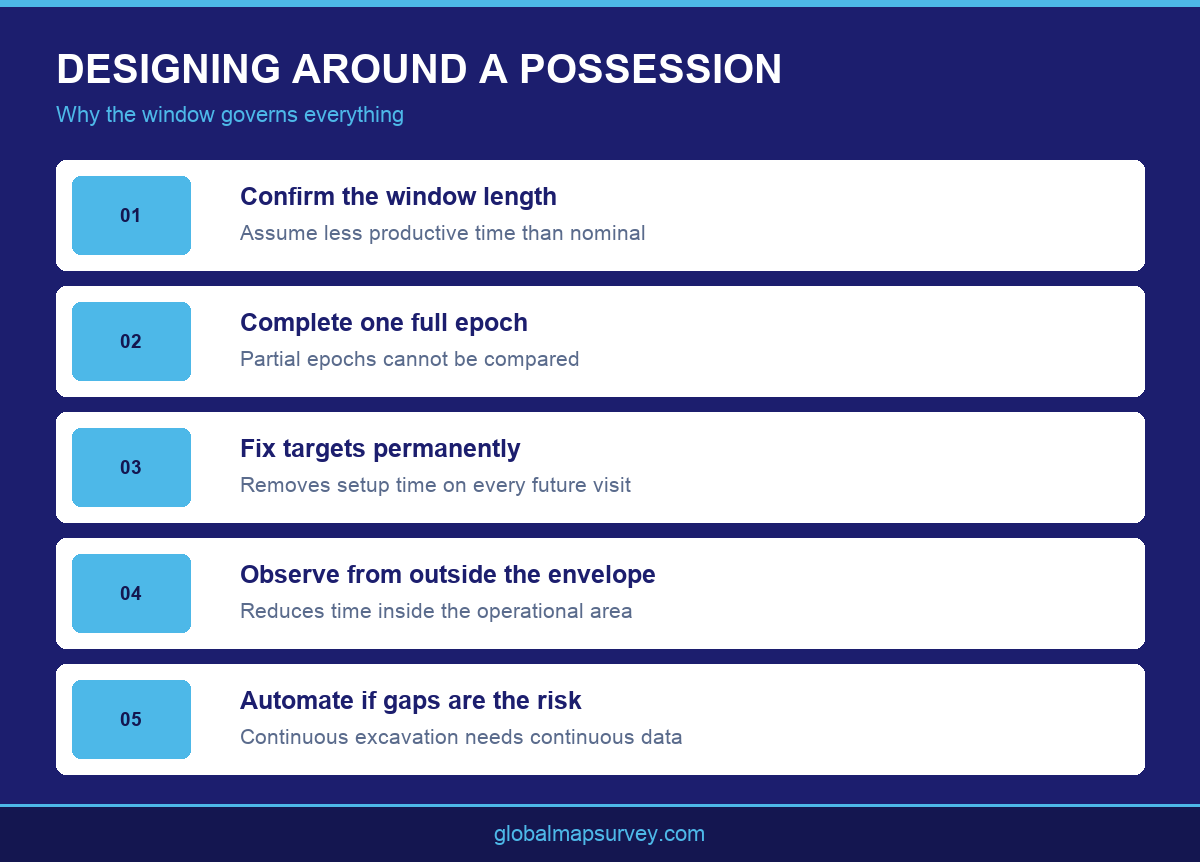
Access to a live railway is granted in possessions, which are defined windows when the line is closed to traffic. They are usually short, often overnight, and they are the single biggest constraint on how a monitoring programme can be designed.
A full observation epoch has to fit inside the window with contingency, because an epoch that cannot be completed is data that cannot be compared. This pushes programme design toward permanently fixed targets, observation from positions outside the track envelope, and routines rehearsed so setup time is minimal.
Safety requirements add further overhead. Personnel need rail specific certification, work is supervised, and equipment brought near the track is controlled. None of this is negotiable, and all of it consumes part of the window, so realistic planning assumes considerably less productive time than the nominal possession length.
Weather compounds the constraint. Possessions are often granted overnight, when temperature differentials between rail, ballast and air are changing quickly, and that affects both the structure and the observations. Recording conditions during each possession helps explain readings that would otherwise look inconsistent between one epoch and the next.
Marking out and protecting equipment inside a rail corridor is its own discipline. Anything left near a live line has to be secured so it cannot foul the track or be displaced by passing traffic and airflow. Instruments, cabling and targets all need mounting arrangements approved by the operator, and that approval process should be started well before the possession is booked rather than alongside it.
Where Automated Monitoring Earns Its Cost
Rail is the clearest case for automated systems. When access is limited to occasional short possessions but the risk from adjacent works is continuous, manual observation leaves gaps exactly when movement is most likely to develop.
Automated monitoring using fixed instruments observing permanent targets removes that gap. Readings can be taken through the night and between possessions, alarms can be configured against operator trigger levels, and the data arrives without anyone going near the track. On a scheme with tight limits and continuous excavation nearby, this is often the only way to meet the requirement at all.
The trade off is installation. Instruments and targets have to be fixed during a possession, power and communications provided, and the system proven before it is relied upon. That mobilisation is a real cost, so automation suits programmes running for months rather than weeks.
Reliability of the installation becomes critical once the programme depends on it. An automated system that fails between possessions cannot be repaired until the next access window, which may be weeks away. Redundant instruments, remote diagnostics and power arrangements that tolerate interruption are worth specifying, because the cost of a gap in the data is far higher here than on a conventional site.
Reporting to a Rail Operator
Operator reporting is more prescriptive than most construction monitoring. There is usually a defined format, a defined frequency, and a defined escalation route when a trigger is approached, and these are set by the operator rather than proposed by the survey team.
Reports need to state clearly whether limits have been exceeded, and to distinguish between measured movement and measurement uncertainty. A reading close to a trigger that falls within survey noise needs to be presented as such, because the operational response to a genuine exceedance is disruptive and expensive.
Context should be recorded alongside, as with any deformation monitoring programme. The UAE rail network continues to expand under Etihad Rail, which means an increasing number of projects will be built close to live or planned alignments and will carry monitoring obligations. Where ground conditions are the underlying concern, site investigation surveys usually inform the trigger levels.
It also helps to agree in advance who talks to the operator. Monitoring reports that go directly from the survey team to the railway, without the developer seeing them first, create one kind of problem. Reports that are filtered before they reach the operator create a worse one. A defined and transparent route, agreed with all parties at the start, avoids both. Where the corridor is being monitored alongside other work, railroad monitoring is normally treated as a distinct workstream with its own reporting line.
Conclusion
Railroad monitoring services in UAE combine two distinct measurement problems under severe access constraints and limits set by someone other than the client. Programmes succeed when the brief separates geometry from structure, the design fits the possession, and automation is used where continuous coverage is genuinely required. Global Maps Survey Services delivers rail corridor monitoring across the UAE. Contact us to discuss works planned near a live alignment.
AN ISO 9001-2015 CERTIFIED COMPANY