
Home \ Blog \ Building Settlement Monitoring in UAE: Setting Trigger Levels
Building Settlement Monitoring in UAE: Setting Trigger Levels
August 17, 2026
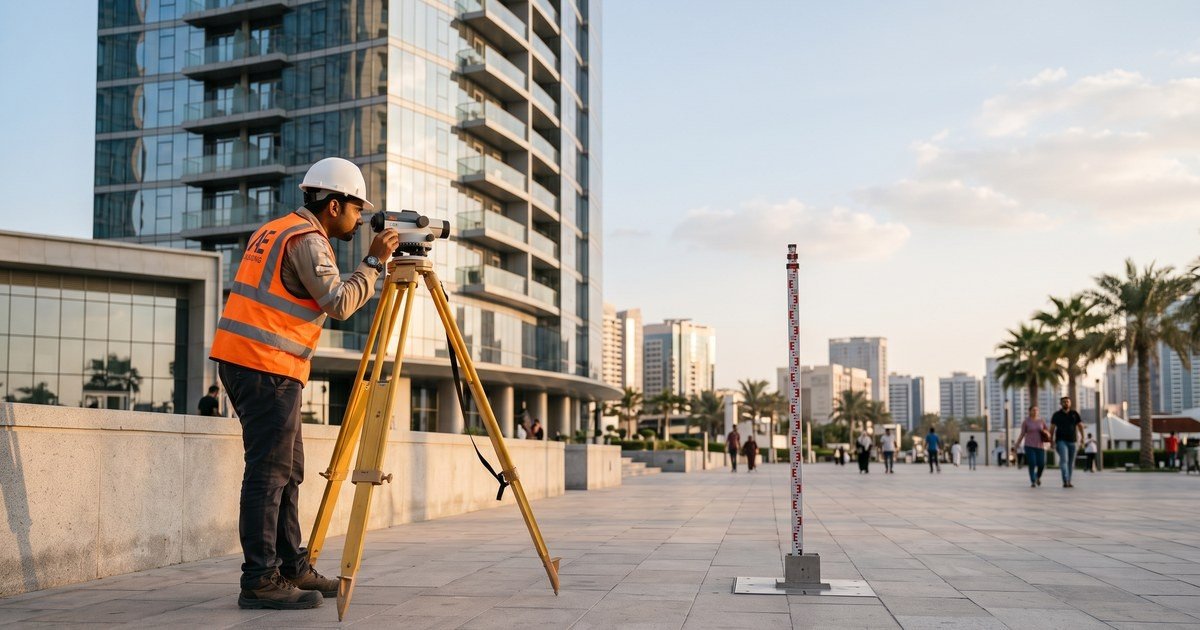
Building settlement monitoring in UAE is rarely commissioned because someone is curious about how a structure is behaving. It is commissioned because a neighbouring excavation has started, a crack has appeared, or a contract demands it. The trouble is that a monitoring programme set up in a hurry usually produces numbers nobody knows how to act on. This guide covers what makes the readings useful: where points go, how often you read them, and what happens when a value moves.
Key Takeaways
- A settlement monitoring programme is only as good as its baseline. Readings taken after excavation has already begun cannot tell you what the structure did before it.
- Trigger levels should be agreed by the structural engineer before monitoring starts, not invented once a reading looks alarming.
- Frequency should follow the work causing the risk, not the calendar. Quiet periods need fewer readings than active dewatering or piling.
Why Settlement Monitoring Starts Before the Risk Does
The single most common failure in building settlement monitoring is starting too late. A monitoring programme measures change, and change can only be measured against a known starting point. If the first readings are taken after piling or dewatering has begun, any movement already caused by that work is silently absorbed into the baseline and disappears from the record.
A proper baseline is not one set of readings. It is a short series taken over several days under stable conditions, which lets the survey team confirm the points are stable and that the instrument is repeating. Only once those readings agree with each other should the baseline be fixed and the programme declared live.
This matters commercially as much as technically. If a neighbouring owner later claims your works damaged their building, a baseline established before you broke ground is the difference between a defensible position and an argument you cannot win.
Baseline effort is also what makes the closing report meaningful. At the end of a programme the question asked is almost always whether total movement stayed inside what the design allowed, and that figure is measured from the baseline. A weak starting point produces a closing number nobody can defend, which is an awkward position to be in when the structure has actually performed perfectly well.
Choosing and Fixing Monitoring Points
Monitoring points need to move with the structure and nothing else. A point fixed to render, cladding, a services duct or a non structural partition will report movement in that element rather than in the building. The result is noise that looks like settlement and triggers unnecessary alarm.
Points are normally set into primary structural elements such as columns, load bearing walls and pile caps, positioned so that a level line can reach them without excessive instrument moves. Spacing follows the structural grid rather than convenience, because the engineer needs to see differential movement between adjacent supports, not just overall sinking.
Every point should be given a permanent identifier, photographed on installation and recorded with a sketch showing exactly where it sits. Points get painted over, built around and knocked off. Without that record, a replacement point cannot be tied back to the original series and the history is broken.
Access should be considered at the same time as position. A point that requires scaffolding or a permit to reach will be skipped on busy days, and a series with gaps is far harder to interpret than a series from a slightly less ideal but reachable location. The best monitoring point is one the team can observe reliably every time, in the same way, for the whole programme.
Setting Trigger Levels That Actually Trigger Something
A trigger level is a movement value that changes what happens next. Most programmes use a tiered arrangement, often described as green, amber and red, where each tier carries a defined response. Without those responses written down, the levels are decoration.
The values themselves are a structural engineering decision, not a survey decision. They depend on the structure, its condition, its foundation type and what it is sensitive to. A settlement figure that is unremarkable under a warehouse slab may be serious beneath a tiled facade or a rigid frame. The survey team’s job is to make sure the monitoring accuracy is comfortably finer than the smallest trigger, so a genuine exceedance can be distinguished from measurement noise.
Response actions need naming as well as numbers. Amber might mean increased frequency and notification of the engineer. Red might mean stopping the activity causing the movement. Agreeing this at the outset avoids the situation where a reading arrives, everyone stares at it, and nothing is done for a week.
Trigger levels also need an owner. Someone has to receive the report, compare it against the levels and start the agreed response, and that responsibility should sit with a named role rather than with the project generally. Programmes that exceed a trigger and do nothing usually fail here rather than in the measurement, because the data arrived but reached nobody with authority to act on it.
Deciding How Often to Read
Frequency should track the activity driving the risk. Piling, deep excavation, dewatering and tunnelling are the periods when movement develops fastest, and readings during those windows may be needed daily or more often. Once the work moves away and readings settle into a flat trend, intervals can lengthen.
Fixed weekly or monthly schedules feel tidy but they usually get both ends wrong. They under sample the risky period and waste effort during the quiet one. A programme that steps up and down with the construction sequence gives the engineer better information for the same budget.
Where continuous coverage is genuinely needed, automated monitoring using fixed instruments and sensors removes the gap between site visits. It is more expensive to install, so it tends to be reserved for structures where the consequence of missed movement is severe.
Weather and site conditions influence the schedule as well. Readings taken during a sandstorm or in extreme afternoon heat carry more uncertainty than readings taken in stable early morning conditions. Building a preferred observation window into the programme, rather than fitting readings around whatever time is convenient, removes a source of variation that otherwise sits in the data permanently.
Reading the Results Without Over Reacting
Not every change in a reading is settlement. Temperature affects both structures and instruments, and daily heat cycles in the UAE are large enough to produce apparent movement that reverses overnight. Readings taken at consistent times of day, with conditions recorded, are far easier to interpret.
Trend matters more than any single value. One point showing an isolated jump usually means something happened to the point. Several adjacent points moving together in the same direction over successive readings is a pattern, and patterns are what the structural engineer needs to see. This is also why structural settlement surveys are reported as time series rather than as snapshots.
Reporting should present movement against the baseline, against the previous reading and against the trigger levels, with a plain statement of whether anything has been exceeded. A report that requires the reader to do their own arithmetic will not be read carefully, which defeats the purpose of collecting the data. Where wider ground settlement monitoring is running alongside, the two data sets should be read together.
Ground movement can extend well beyond the structure being watched, particularly where dewatering is involved, and regional subsidence behaviour can affect a whole area rather than one plot. Where readings across every point drift in the same direction at a similar rate, the cause is more likely to be ground wide than structural, and precise levelling across an extended network is what distinguishes the two.
Conclusion
Building settlement monitoring in UAE works when the baseline is honest, the points are fixed to real structure, the trigger levels carry agreed actions and the frequency follows the risk. Get those four right and the data answers questions instead of raising them. Global Maps Survey Services designs and runs monitoring programmes across Abu Dhabi and the wider UAE, from baseline through to closeout reporting. Talk to our monitoring team about the structure you need to watch.
Frequently Asked Questions
When should building settlement monitoring start on a project?
Before any activity that could cause movement begins, including site clearance. The baseline must be established and confirmed stable while conditions are undisturbed, otherwise early movement is absorbed into the starting values and never appears anywhere in the record.
Who sets the trigger levels for a monitoring programme?
The structural engineer responsible for the building or the temporary works sets them. The survey team confirms that monitoring accuracy is fine enough to detect those levels reliably, but does not decide what movement the structure can safely tolerate.
What is the difference between settlement and deformation monitoring?
Settlement monitoring tracks vertical movement of a structure or the ground beneath it. Deformation monitoring is broader and covers movement in any direction, including tilt, lateral displacement, rotation and changes in shape across a whole structure.
How many monitoring points does a building need?
It depends on the structural grid and the assessed risk rather than the floor area. Points are placed so the engineer can see differential movement between adjacent supports, which usually means following column lines and load bearing wall positions.
Can monitoring points be replaced if they are damaged?
Yes, but a replacement starts a new series unless it can be tied back to the original position by survey. This is exactly why installation photographs and location sketches are recorded for every point at the outset of the programme.
Does temperature affect settlement monitoring readings?
Yes, significantly. Structures and instruments both respond to heat, and daily temperature swings in the UAE can produce apparent movement that reverses overnight. Reading at consistent times and recording site conditions makes the resulting data far easier to interpret.
How long should a monitoring programme run after construction finishes?
Usually until readings show a stable trend for an agreed period. Movement often continues after works stop, so ending a programme on the day the contractor demobilises can easily miss the tail of the settlement curve and its final magnitude.
Is automated monitoring always better than manual surveys?
Not always. Automated systems remove gaps between site visits and suit high consequence structures, but they cost considerably more to install. Manual survey remains appropriate where movement is slow and readings can be scheduled around the construction works.
What should a settlement monitoring report contain?
Movement against the baseline, movement since the previous reading, comparison against the agreed trigger levels, and a clear written statement of any exceedance. Our monitoring services pages set out the standard deliverables issued on every programme we run.
How do I commission a settlement monitoring programme?
Start with the structure at risk, the activity creating that risk, and the movement limits set by your engineer, then agree point positions and triggers. You can contact our survey team to scope a programme for a specific site.
AN ISO 9001-2015 CERTIFIED COMPANY